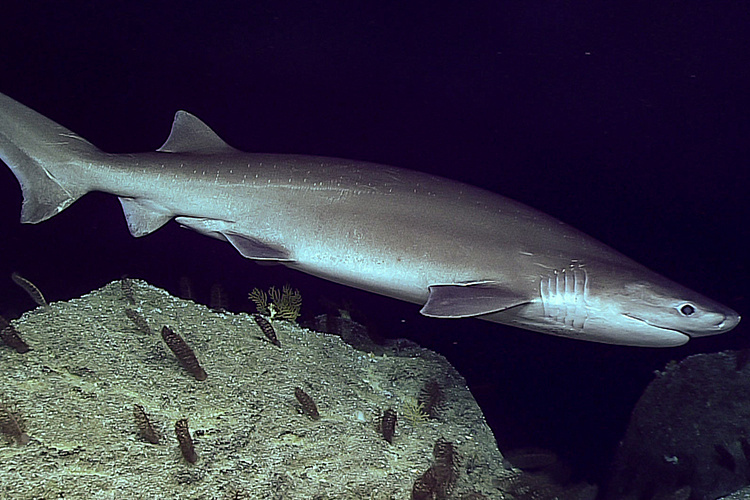
Hi, friends at Southern Fried Science!
You’ve probably seen in the media lately that there’s been a lot of coverage about whether sharks are being killed for SARS-CoV-2 vaccines. With an awesome undergraduate co-author, I’ve tried to gather some facts about what is happening (or might happen) and what it means. You can read a preprint of that work here, or read on for a short FAQ in plain English.
Is there really shark in vaccines?
In some of them, yes. Squalene is derived from shark liver oil, and is an ingredient in adjuvants used in a previous commercially available flu vaccine as well as several vaccines currently being tested for SARS-CoV-2. Adjuvants make vaccines work better (by promoting a stronger immune response) and reduce the amount of antigen required for each vaccine dose, allowing them to be manufactured more rapidly.
Will it really take 500,000 sharks to vaccinate everyone during the pandemic?
No—it’s a “worst case scenario” estimate based on the assumption that we’ll be vaccinating 7.8 billion people twice (15.6 billion doses, 10 mg squalene/dose) and that it takes 2,500-3,000 sharks to generate a ton of squalene. 500,000 sharks falls within a plausible range if that were actually what we were going to do, but it isn’t (because it’s unlikely that only one vaccine candidate will succeed, or if it did, that it will also be one that contains squalene–and because sadly, everyone on earth isn’t likely to have access to a vaccine anytime soon).
Even if these assumptions all turned out to be accurate, a specific number of sharks needed is difficult to estimate with any meaningful precision, because we know that shark species vary substantially not just in size, but in the proportion of their body mass made up of liver, the amount of oil their livers contain, and how much of that oil is squalene. Based on fairly moderate assumptions about yield for each of those variables, it would take about 365,385 “average-sized” sharks to generate the amount of squalene needed for 15.6 billion doses. But across the different yield variables and shark sizes, the range of estimates becomes so large it feels meaningless.
What does this all mean for shark conservation?
It really depends. The required amount of squalene could easily be harvested from existing shark fisheries (which catch an estimated 100 million sharks a year). If we started saving instead of discarding livers from sharks that are already being caught for their fins or meat, the use of those livers in vaccines wouldn’t have much effect on shark populations at all. On the other hand, deep-sea sharks are historically a preferred source of liver oil (they are more likely to provide high yields because of biological adaptations to living in the deep-sea). If demand led to increased targeting of deep-sea sharks–which are understudied and generally very vulnerable to overfishing–that could have serious conservation consequences for targeted species. So the question of whether demand for squalene for vaccines is a conservation problem depends a lot more on how that demand is being met than on the total number of sharks required.
What alternatives do we have?
We can derive chemically identical squalene from plant sources, and at least at the moment, wholesale prices for plant- and shark-derived squalene are very similar. It seems like a good idea to encourage an infrastructure shift towards sustainable plant-based sources rather than relying for medical purposes on shark fisheries, since many are undermanaged or unsustainable, making access vulnerable to population collapses or changes in regulation. If we are going to continue to rely on shark-derived squalene, we should ask for clarity and specificity from pharmaceutical companies about their supply chains, the species being harvested for use in vaccines, and the sustainability of that harvest.
Shouldn’t human life come first in a pandemic?
I think this is a false choice. The FDA doesn’t actually care where squalene comes from (plants or sharks) because the squalene itself (C₃₀H₅₀) is chemically identical; pharmaceutical companies order it by CAS registry number based on chemical composition, not origin. Regulations require that component lots be “tested for conformity with all appropriate written specifications for purity, strength, and quality” (21 C.F.R. § 211.84 (2019)). Assuming plant-derived squalene meets those standards (and we know it can) it can easily be substituted for shark-derived squalene because as far as the regulations are concerned, they’re the same thing. Environmental sustainability and human health goals are not necessarily in opposition, and there’s nothing wrong with wanting to make choices which support the well-being of both people and sharks.
You can read more coverage of this topic and research in Forbes and the New York Times, or by reading the preprint itself.
—
A note to my friends in epidemiology or shark science: if you have information or sources you are willing to direct me to which you think are relevant to improving or clarifying this work, or would like to point out an angle I should consider, please feel invited to reach out (catherine.macdonald@rsmas.miami.edu). The best thing about a preprint is that it leaves a lot of space for our community to help improve the quality or usefulness of research before a finalized version is published!