There’s been quite a bit going on behind the scenes over at Southern Fried Science, across the Gam, and in the marine blogging world these last few weeks. A few updates for you all:
Oceana is accepting nominations for their Ocean Hero award until April 27th. There are two categories: adult (over 18) and junior (under 18). According to the contest rules: “Any individual who has volunteered, organized, cleaned up or otherwise acted in a way that benefits the world’s oceans, its inhabitants or the communities and peoples that … Read More “Nominations now open for the Oceana Ocean Hero award!” »
All this month we’ve be showing talks about how nature and evolution have inspired technology and design. I’d like to end with this talk by Jim Toomey, about how the nature simply inspires us as human beings. What stories have the oceans shared with you?
Amongst my field gear is a buzz off shirt, hat, and bandana that were purchased in Alaska to ward off the state bird – the mosquito. Upon arriving to Fairbanks, I realized within the space of a few days that I would need some better bug gear for my tenure there and found a local store stocked with an entire floor of their store featuring buzz off gear.
Ex Officio definitely has a style that carries over into their bug gear, making it a cross between travel gear and classic field clothes. I kind of wish they had included their travel pockets in the shirt, for instance. But they’ve included the buzz off chemical, whatever that may be, into their quick-dry cloth, meaning that you can wash and wear while traveling.
The focus on community and informal rules that were found to frequently structure successful commons management made apparent that the word ‘policy’ needed to be expanded. Policy scholars now look beyond the official written laws, reports, and regulations that are often written by a central government to multi-scalar rules that govern the structure and behavior in a system (Ostrom 2005). They include non-written cultural norms, religious prescriptions, and community ethics that are often more strongly followed that written, formal rules (Berkes 2008). Along with a more broadly defined concept of policy, commons scholars also introduced a more broad definition of institution within which these policies are made and enforced. Much like policies, institutions can be governmental as well as religious, moral, or cultural. Hanna and Jentoft (1996) give an appropriately broad definition for natural resource institutions: “institutions represent the arrangements which people devise to control their use of the natural environment”. Ostrom (2005) promotes an institutional analysis in order to encompass these new conceptions of policy and institution. Her work recently earned the Nobel prize and is rapidly becoming the most used framework for policy analysis.
Ostrom’s Institutional Analysis and Design (IAD) Framework is not specific for natural resources or even commons problems, but serves as a place to begin policy analysis for all sorts of policy problems, including education, gender relations, crime, and natural resources. A short description here does not fully describe the IAD framework – for that, refer to Ostrom’s 2005 book. To highlight a few pertinent features, the framework is centered around a decision-making arena called the action arena rather than on the formation of a particular policy. Inputs to the action arena include exogenous variables describing the biophysical characteristics, community factors, and existing rules relating the action arena in play. This action arena then interacts with action arenas at other levels of governance (operational, collective choice, constitutional, and super-constitutional) to form an outcome. The outcome is evaluated by some defined set of criteria and the process feeds back to become iterative. The main benefit of the framework is to allow for comparative studies between empirical studies by scholars around the world in many disciplines.
We see so many powerful designs in nature, yet when we design our own structure we tend to build rigid, fixed, industrial beasts. What designs in nature inspire you? How do we break away from a culture of hard edges and inflexible machines?
At the end of each summer, I generally have a distinctive “z” shaped tan on my feet from wearing Chacos almost every day. I originally got a pair upon the suggestion of a friend on my field crew while working in Olympic National Park and that pair lasted me almost 5 years. They became my best friend as a sandal in which I could walk up fairly large hills and with which I could backpack in the summers. Much like many of my shoes, they also work well around town or while traveling since they look fairly nice as well.
The Beneath the Waves Film Festival begins tomorrow night. The lineup includes films by students, conservation organizations, and professional filmmakers. Topics include overfishing, biodiversity, marine mammals, sharks, and more. In the coming weeks, we’ll post some of our favorite movies on Southern Fried Science. In the meantime, here is the introductory film.
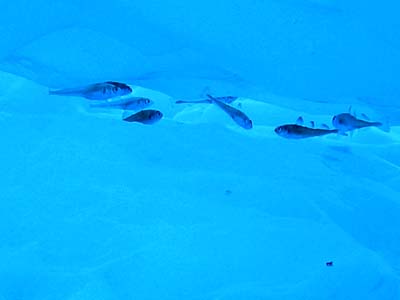
A few years back I attended a mid-field season gathering of researchers working on International Polar Year projects. We were lucky enough to have collected the marine biologists, recently returned from a short cruise out of Barrow, AK with the mission to describe the biota living on the underside of the sea ice that is so critical to terrestrial Arctic ecology. It was absolutely stunning to me to realize that there is a whole ecosystem associated with the bottom of the ice, an ephemeral, threatened resource.
Depending on the time of year, sea ice covers 3-7% of the planet, making this relatively unexplored ecosystem fairly important to global biogeochemical processes. The algae trapped in and under sea ice, for example, accounts for 25% of the Arctic’s and 20% of the Antarctic’s primary productivity. This productivity trickles up the food web to the more well-known ice dwellers, such as polar bears and seals.

 Amongst my field gear is a buzz off shirt, hat, and bandana that were purchased in Alaska to ward off the state bird – the mosquito. Upon arriving to Fairbanks, I realized within the space of a few days that I would need some better bug gear for my tenure there and found a local store stocked with an entire floor of their store featuring buzz off gear.
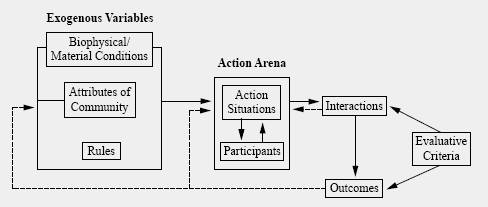 Ostrom’s Institutional Analysis and Design (IAD) Framework is not specific for natural resources or even commons problems, but serves as a place to begin policy analysis for all sorts of policy problems, including education, gender relations, crime, and natural resources. A short description here does not fully describe the IAD framework – for that, refer to Ostrom’s 2005 book. To highlight a few pertinent features, the framework is centered around a decision-making arena called the action arena rather than on the formation of a particular policy. Inputs to the action arena include exogenous variables describing the biophysical characteristics, community factors, and existing rules relating the action arena in play. This action arena then interacts with action arenas at other levels of governance (operational, collective choice, constitutional, and super-constitutional) to form an outcome. The outcome is evaluated by some defined set of criteria and the process feeds back to become iterative. The main benefit of the framework is to allow for comparative studies between empirical studies by scholars around the world in many disciplines.
 At the end of each summer, I generally have a distinctive “z” shaped tan on my feet from wearing Chacos almost every day. I originally got a pair upon the suggestion of a friend on my field crew while working in Olympic National Park and that pair lasted me almost 5 years. They became my best friend as a sandal in which I could walk up fairly large hills and with which I could backpack in the summers. Much like many of my shoes, they also work well around town or while traveling since they look fairly nice as well.