Skip to content

Southern Fried Science

Over 15 years of ocean science and conservation online

  • Home
  • About SFS
  • Authors
  • Support SFS

New “Rescue a Reef” citizen science project focuses on coral restoration. You can help!

Posted on February 25, 2014 By David Shiffman
Uncategorized

Rescue-a-Reef-logoCoral reefs provide critical habitat to countless unique species of animals and plants. However, many reefs are in trouble, being hammered by climate change, destructive fishing techniques, pollution, disease, and other threats. A coral restoration project at the University of Miami’s (UM) RJ Dunlap Marine Conservation Program aims to rescue Florida’s reefs through coral restoration. The research focuses on an important and endangered reef-building coral called staghorn.

How coral reef restoration works 

UM researchers grow staghorn coral in an underwater nursery to create a sustainable source of healthy coral colonies. Once a colony reaches the right size, the researchers  transplant these new corals  onto a damaged wild reef  through a process called “outplanting”. This creates a new population of corals that helps restore and conserve the natural reef.
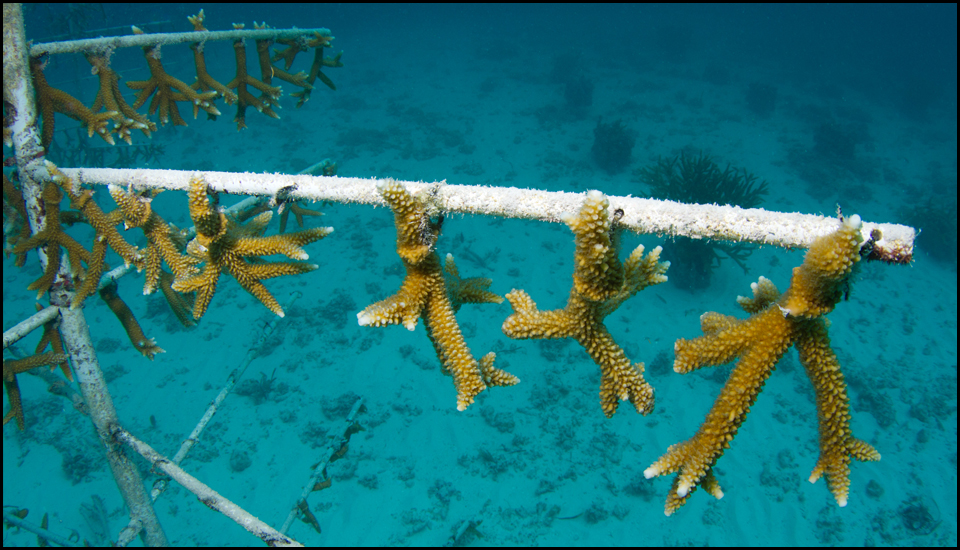
Small colonies of staghorn coral outplanted in a nursery. Photo courtesy Dr. Diego Lirman.
Small colonies of staghorn coral growing in a nursery prior to transplantation onto damaged wild reefs. Photo courtesy Dr. Diego Lirman.


Dr. Diego Lirman, a professor at the University of Miami and a lead scientist of the Rescue a Reef program, said, “working on active coral reef restoration makes us feel part of the solution. After watching populations of important reef-building corals decline over the past three decades, we have an opportunity to contribute to their persistence and recovery. Using very simple techniques and inexpensive materials, we are exploiting a key attribute of the life history of branching corals (i.e., propagation by fragmentation) to create a sustainable and genetically diverse source of coral colonies for reef restoration and population recovery.”

This method of coral reef restoration has been used for decades and has been shown to be effective. Dr. Lirman’s team has outplanted over 2,500 staghorn coral colonies in recent years, and over 90% of them have survived.

How you can help

Donate! This project is supported by donations from the interested public, and you can donate here. Any amount helps, but larger donations have associated rewards, including:

1) Naming a patch of restored reef
or
2) Participating in a citizen science coral restoration trip, where you will be able to SCUBA dive with the Rescue a Reef research team and actively help plant and maintain coral nurseries!


Share this:

  • Click to share on Bluesky (Opens in new window) Bluesky
  • Click to share on Facebook (Opens in new window) Facebook
  • Click to share on Reddit (Opens in new window) Reddit
  • Click to share on Threads (Opens in new window) Threads
  • Click to share on WhatsApp (Opens in new window) WhatsApp
  • Click to share on Mastodon (Opens in new window) Mastodon

Related

Post navigation

❮ Previous Post: Angler gives up world record to release massive shark alive
Next Post: Fun Science Friday – Using the Force to Detect Cancer…. Sorta ❯

Popular Posts

What Ocean Ramsey does is not shark science or conservation: some brief thoughts on "the Shark Whisperer" documentaryWhat Ocean Ramsey does is not shark science or conservation: some brief thoughts on "the Shark Whisperer" documentaryJuly 2, 2025David Shiffman
That's not a blobfish: Deep Sea Social Media is Flooded by AI SlopThat's not a blobfish: Deep Sea Social Media is Flooded by AI SlopDecember 19, 2025Andrew Thaler
I can serve on your graduate thesis committee. Here’s what you can expect of me, and what I expect in return.I can serve on your graduate thesis committee. Here’s what you can expect of me, and what I expect in return.October 16, 2025David Shiffman
The story of the pride flag made from NASA imagery: Bluesky's most-liked imageThe story of the pride flag made from NASA imagery: Bluesky's most-liked imageSeptember 27, 2024David Shiffman
What can the funniest shark memes on the internetz teach us about ocean science and conservation?What can the funniest shark memes on the internetz teach us about ocean science and conservation?November 8, 2013David Shiffman
Shark of Darkness: Wrath of Submarine is a fake documentaryShark of Darkness: Wrath of Submarine is a fake documentaryAugust 10, 2014Michelle Jewell
The Trouble with Teacup PigsThe Trouble with Teacup PigsOctober 14, 2012Andrew Thaler
I turned my woodshop into a personal solar farm.I turned my woodshop into a personal solar farm.June 21, 2021Andrew Thaler
Norway and Cook Islands put their deep-sea mining plans on pause.Norway and Cook Islands put their deep-sea mining plans on pause.December 3, 2025Andrew Thaler
Nodules, Lost Mines, and Dark Oxygen: A new documentary on deep-sea mining asks important questions about the future of the industry.Nodules, Lost Mines, and Dark Oxygen: A new documentary on deep-sea mining asks important questions about the future of the industry.July 24, 2025Andrew Thaler
Subscribe to our RSS Feed for updates whenever new articles are published.

We recommend Feedly for RSS management. It's like Google Reader, except it still exists.

Southern Fried Science

  • Home
  • About SFS
  • Authors
  • Support SFS


If you enjoy Southern Fried Science, consider contributing to our Patreon campaign.

Copyright © 2025 Southern Fried Science.

Theme: Oceanly Premium by ScriptsTown