Skip to content

Southern Fried Science

Over 15 years of ocean science and conservation online

  • Home
  • About SFS
  • Authors
  • Support SFS

The Pacific Divided

Posted on October 7, 2011October 5, 2011 By Bluegrass Blue Crab 2 Comments on The Pacific Divided
Science

Challenge: find a map of the Pacific Ocean that includes both Japan and California. Or that focuses on any of the island nations in between.

One of the casualties of mapping a three-dimensional planet on two-dimensional paper is the part of the world that is split between the edges of the paper. Usually, this is the Pacific. As Sarah Palin made famous in the 2008 presidential campaign, as an Alaskan, she can see Russia from her house. While I admit that for Palin, this is an exaggeration, but for the residents of St. Lawrence Island, this view is a reality. In fact, they are as likely (if not more) to speak Russian than English and have the capability of kayaking to Russia if so desired. But your average world map makes that distance look infinite.
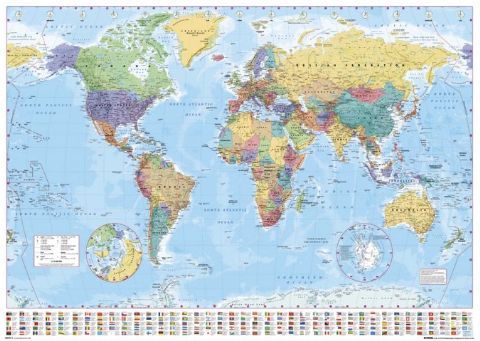
What if we conventionally centered maps around the Pacific instead of Europe? A Google image search of “world map” took until the bottom of page 4 to find something that didn’t cut the Pacific in half. Even then, the map included extra bits; it wasn’t centered on the Pacific.
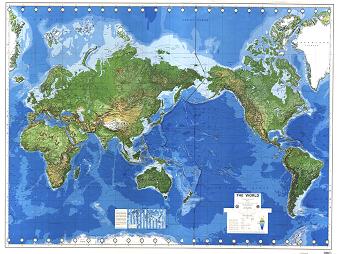
www.mapcenter.com

It would be a very different view. We tend to forget about what falls at the edges if it’s not visually connected and this can have very real consequences.

For instance, the nuclear fallout from Fukushima was often referred to as ‘lucky’ because the primary plume extended over the empty Pacific. As was pointed out in a New York Times OpEd, the Pacific isn’t empty space. There are nations there in addition to many important marine resources, not to mention charismatic fauna that capture worldwide imagination. The citizens of those nations never really get a fair cartographic representation. Some would go so far as to say that this is a form of elitism and ethnocentrism, placing the Europe in the center of the world as it stood in the minds of historic cartographers that first mapped the world. It might be time to revisit and re-center.
Share this:

  • Click to share on Bluesky (Opens in new window) Bluesky
  • Click to share on Facebook (Opens in new window) Facebook
  • Click to share on Reddit (Opens in new window) Reddit
  • Click to share on Threads (Opens in new window) Threads
  • Click to share on WhatsApp (Opens in new window) WhatsApp
  • Click to share on Mastodon (Opens in new window) Mastodon

Related

Tags: map Pacific

Post navigation

❮ Previous Post: Misunderstood Marine Life #2 – moray eels
Next Post: Misunderstood Marine Life # 1 – The five biggest myths about Marine Biologists ❯

You may also like

Weekly Salvage
Everything about hagfish is the best thing about hagfish, the battle for the deep-sea heats up, parasitic butt snails, and more! Monday Morning Salvage: December 17, 2017
December 18, 2017
Weekly Salvage
Southern Fried Science year-in-review, Palau’s Giant, a new challenge for deep-sea mining, Porgs are Puffins, and more! Monday Morning Salvage: December 25, 2017.
December 25, 2017
Weekly Salvage
The fate of the deep sea is being decided behind closed doors, plastic in the deepest trench, memories of whales, and more! Monday Morning Salvage: March 4, 2019
March 4, 2019
Featured
What I’m watching for at this month’s ISA meeting: How to Value Cultural Heritage on the High Seas?
March 21, 2024

2 thoughts on “The Pacific Divided”

  1. Fraser H says:
    October 7, 2011 at 2:18 pm

    In Australia most world maps tend to be centered on Australia (e.g. http://shop.australiangeographic.com.au/World-Map-Poster-P1429.aspx ) but still are quite poor on Small Island Pacific States..

  2. WhySharksMatter says:
    October 7, 2011 at 11:06 pm

    I prefer this map:

    http://images.google.com/imgres?q=world+according+to+americans&num=10&hl=en&gbv=2&biw=1366&bih=667&tbm=isch&tbnid=XTKqvepv-6XnRM:&imgrefurl=http://www.ritholtz.com/blog/2009/11/the-world-according-to-americans/&docid=o1nvqy_trg3MEM&w=917&h=589&ei=1L2PTp77AsmvsQLe0IWmAQ&zoom=1

Comments are closed.

Popular Posts

What Ocean Ramsey does is not shark science or conservation: some brief thoughts on "the Shark Whisperer" documentaryWhat Ocean Ramsey does is not shark science or conservation: some brief thoughts on "the Shark Whisperer" documentaryJuly 2, 2025David Shiffman
That's not a blobfish: Deep Sea Social Media is Flooded by AI SlopThat's not a blobfish: Deep Sea Social Media is Flooded by AI SlopDecember 19, 2025Andrew Thaler
I can serve on your graduate thesis committee. Here’s what you can expect of me, and what I expect in return.I can serve on your graduate thesis committee. Here’s what you can expect of me, and what I expect in return.October 16, 2025David Shiffman
The story of the pride flag made from NASA imagery: Bluesky's most-liked imageThe story of the pride flag made from NASA imagery: Bluesky's most-liked imageSeptember 27, 2024David Shiffman
What can the funniest shark memes on the internetz teach us about ocean science and conservation?What can the funniest shark memes on the internetz teach us about ocean science and conservation?November 8, 2013David Shiffman
Shark of Darkness: Wrath of Submarine is a fake documentaryShark of Darkness: Wrath of Submarine is a fake documentaryAugust 10, 2014Michelle Jewell
The Trouble with Teacup PigsThe Trouble with Teacup PigsOctober 14, 2012Andrew Thaler
I turned my woodshop into a personal solar farm.I turned my woodshop into a personal solar farm.June 21, 2021Andrew Thaler
Norway and Cook Islands put their deep-sea mining plans on pause.Norway and Cook Islands put their deep-sea mining plans on pause.December 3, 2025Andrew Thaler
Nodules, Lost Mines, and Dark Oxygen: A new documentary on deep-sea mining asks important questions about the future of the industry.Nodules, Lost Mines, and Dark Oxygen: A new documentary on deep-sea mining asks important questions about the future of the industry.July 24, 2025Andrew Thaler
Subscribe to our RSS Feed for updates whenever new articles are published.

We recommend Feedly for RSS management. It's like Google Reader, except it still exists.

Southern Fried Science

  • Home
  • About SFS
  • Authors
  • Support SFS


If you enjoy Southern Fried Science, consider contributing to our Patreon campaign.

Copyright © 2025 Southern Fried Science.

Theme: Oceanly Premium by ScriptsTown